A fresh coat of exterior paint should hold its color and its grip for years. When a finish chalks, flakes, or peels early, those exterior paint problems almost always trace back to a decision made before the first coat dried. So before anyone blames the paint in the can, it helps to answer one plain question: how long does exterior paint last, and what quietly steals years off that number? Our crews handle exterior house painting across Northeastern Pennsylvania, and we see the same early failures over and over. And there is a clear pattern behind them. The good news is that most of them are avoidable.
How Long Does Exterior Paint Last in Northeastern Pennsylvania?
So how long does exterior paint last on a real home in a real climate? Most sources land in a familiar range. National data from Angi puts a typical exterior paint job at 5 to 10 years, with an outside range of 3 to 17 years depending on the paint, the prep, the surface, and the weather it faces. Wood siding sits on the shorter end and often needs fresh paint every 3 to 7 years.
| Surface | Typical repaint window |
|---|---|
| Wood siding | 3 to 7 years |
| Most exterior surfaces | 5 to 10 years |
| Painted brick | Up to 17 years |
Our own experience across Northeastern Pennsylvania matches that. With solid prep and quality products, exterior paint here holds up 5 to 10 years before it needs attention. So the honest answer to how long does exterior paint last is “it depends.” A shaded north wall behind good gutters can outlast a sun-baked south wall by years. When you know what drives that gap, the number stops feeling like luck. The paint is rarely the weak link. The prep and the timing usually are.
Why Exterior Paint Fails Early
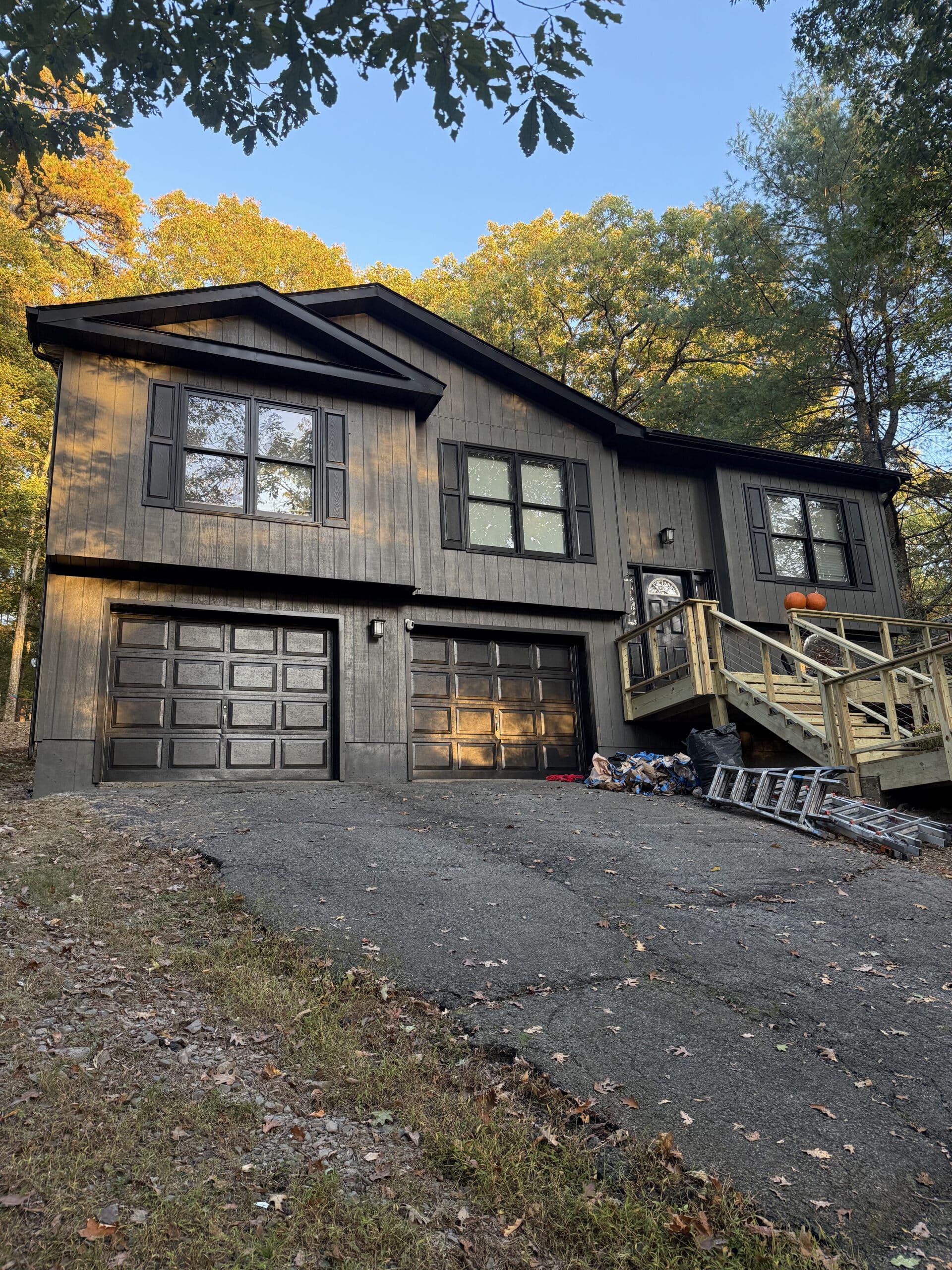
Early failure is rarely a mystery. The same handful of causes show up on almost every job. Here are the exterior paint problems we see most, and what actually drives them.
| What you see | What usually caused it |
|---|---|
| Peeling and blistering | Moisture behind the film, or paint over a damp or dirty surface |
| Fading and chalking | Long sun and UV exposure, common on the south and west walls |
| Cracking and flaking | Coats applied too thick, or in temperatures where the paint could not cure in |
| Losing grip within a year | Skipped washing, no primer, or the wrong season for painting |
Notice the pattern. Almost none of these start with the paint itself. They start with the surface, the moisture, and the timing. Trapped moisture is the top cause of peeling, because water behind the film pushes it off the wall. A surface that was never washed gives new paint dust and chalk to grip instead of solid material. Skip the prep, and you shorten the clock the day the job is done.
But these exterior paint problems carry a second cost. When water sits behind a failing coat, it does not stop at the paint. It reaches the wood underneath. And soft, rotted trim costs far more to repair than a coat of paint. So catching moisture early protects the whole wall, not just the color.
The Weather That Works Against Your Paint
Northeastern Pennsylvania asks a lot of a paint job. Summer sun bakes the south side. Winter brings freeze-thaw cycles that expand and contract every surface on the house, over and over. Paint that cannot move with the wall cracks, and once it cracks, water gets in.
This is where product and timing work together. A quality exterior coat is built to flex. Sherwin-Williams Duration, for one, is made to expand and contract with the surface as temperatures swing. That flex is what keeps it from cracking and peeling in a climate like ours. But flexibility only pays off if the paint cured properly in the first place.
Curing is the part homeowners rarely hear about. Paint needs surface temperatures above 50 degrees to cure into a durable film. In our region, that reliable window runs from April 7th through October 7th. Paint applied when it is too cold never hardens the way it should, and it can start failing within months. That is why our crews do not schedule exterior work in the cold season. Rushing the calendar is one of the fastest ways to turn a 10-year job into a 2-year one.
What Makes Exterior Paint Last Longer
If early failure comes from skipped steps, longer life comes from putting those steps back. A few habits change the answer to the question, how long does exterior paint last, more than any single product does.
None of these steps are costly on their own. Together, they are the difference between paying for a paint job once a decade and paying for one every few years. And together, they turn most common exterior paint problems into a non-issue.
The Real Cost of Paint That Fails Early
Here is the math that makes prep worth it. National data puts a professional exterior repaint around $3,177 on average. When a job fails early, that is not a one-time number. It is a bill you pay again years ahead of schedule, plus any wood rot or moisture damage that crept in while the paint was failing. So the real price of early failure is the second bill, not the first. Most exterior paint problems are cheaper to prevent than to repair.
That is the case for getting it right the first time. A careful exterior painting process is not about doing more for its own sake. It is about washing, prepping, priming, and painting in the right conditions so the finish reaches the full life it was built for. Doing it once, correctly, is almost always cheaper than doing it twice.
A DIY repaint can work on a small, sound surface. But on a full home, the room for error is thin. Sun exposure, aging wood, and freeze-thaw stress all stack up at once. This is where a licensed crew earns its keep. A trained crew catches the moisture and prep issues that cause most early failure before they ever reach the paint.